
Flat roofing
A flat roof is a complete system, not just the surface you can see.
Recurring leaks on a flat roof can come from deterioration in the covering, failed details, drainage issues or other parts of the roof build-up.
That is why the condition should be assessed before deciding whether a local repair or complete replacement is the better route.
01
Signs that a flat roof deserves attention
- Recurring water ingress
- Visible deterioration in the covering
- Splits, damage or failed local details
- Persistent problems after previous repairs
- Standing water that raises concerns about drainage or falls
- Defects around edges, outlets or adjoining walls
02
A patch can be useful—or simply postpone the same problem.
A local repair may be appropriate where the defect is limited, the surrounding roof remains serviceable and the failure can be properly addressed.
Replacement may deserve consideration where the covering is broadly deteriorated, repairs repeatedly fail, defects occur in several areas or the existing roof no longer provides a reliable repair basis.
03
The project scenario uses an EPDM membrane system.
For the fictional Didsbury project, Rookstone uses EPDM as the selected concept system. That choice is specific to the scenario and does not mean EPDM is universally suitable.
A real specification should consider construction, deck condition, falls and drainage, insulation, condensation control, outlets, adjoining walls and manufacturer requirements.
04
What a replacement project can involve
A project may include removing the existing covering, inspecting the deck and supporting construction, agreed substrate repairs, preparing the roof build-up, installing the specified membrane, completing edges, outlets and adjoining details, and final drainage checks.
The Rookstone approach
A clear route from the symptom to the scope.
- 01
Understand the symptom
Where and when is water appearing?
- 02
Inspect the covering and details
Consider the obvious failure and the wider roof.
- 03
Consider drainage and roof build-up
A surface defect may not be the only issue.
- 04
Decide repair or replacement
Explain why the proposed route makes sense.
- 05
Specify the selected system
Describe what will actually be installed.
- 06
Provide a written quotation
Set out the proposed scope before work is agreed.
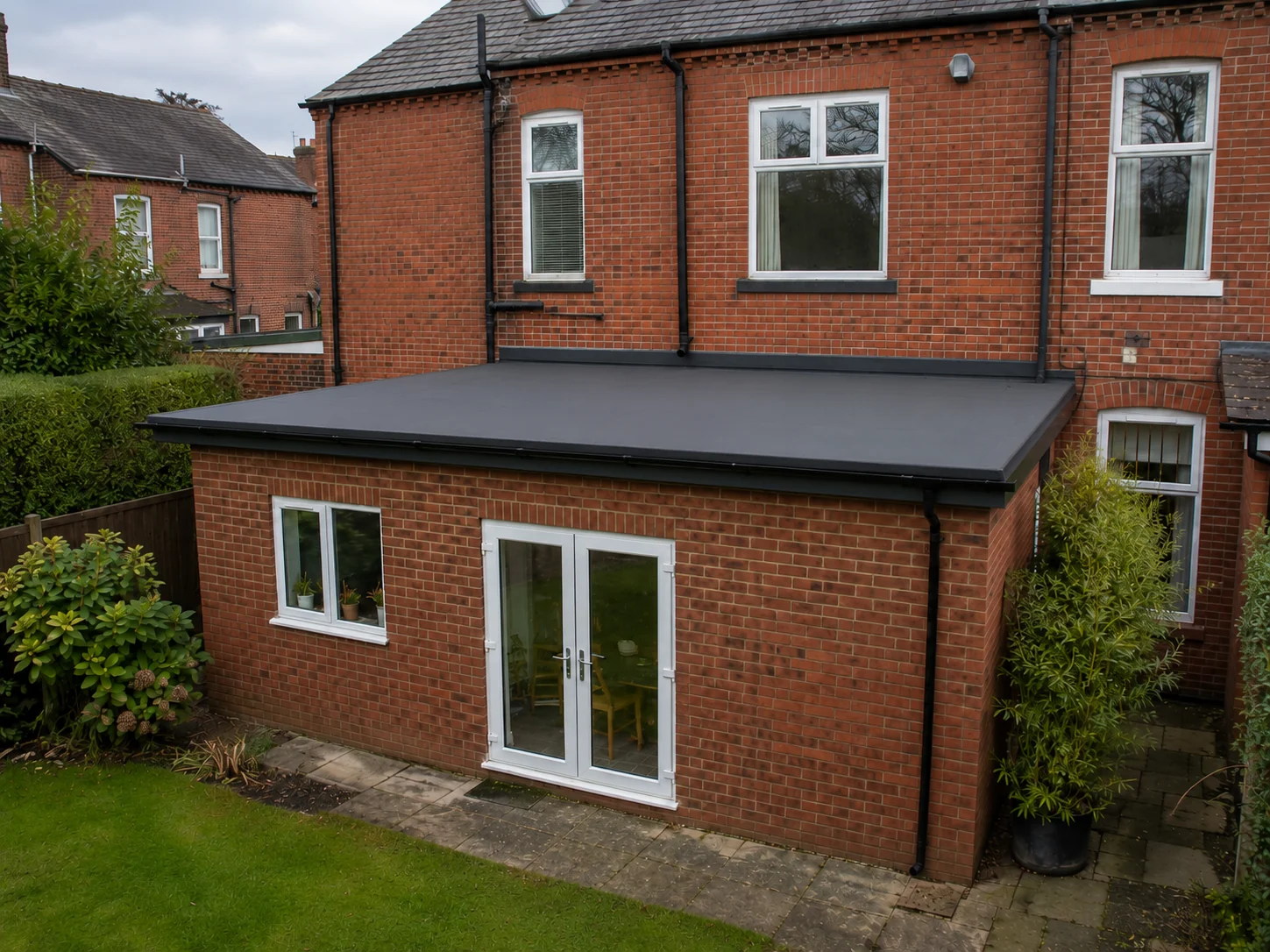
Fictional project scenario
Flat Roof Replacement — Didsbury
This fictional rear-extension roof has recurring leakage and an ageing covering. The scenario demonstrates complete replacement using an EPDM membrane system after repeated local patching is no longer considered sensible.
View project scenarioCommon questions
Questions about flat roofing
Does a leaking flat roof always need replacing?
No. A local repair may be appropriate where the failure is limited and the wider roof remains serviceable.
What is EPDM?
EPDM is a synthetic rubber membrane used in some flat-roof systems. This fictional project uses it as one plausible system.
Is standing water always a sign that the membrane has failed?
Not necessarily. It can raise questions about drainage, falls and detailing, but the cause should be assessed.
Can a new membrane simply be installed over any existing flat roof?
That should not be assumed. Construction, substrate, moisture, insulation, drainage and system requirements need consideration.
How long does a flat roof last?
Service life depends on the system, specification, installation, exposure, detailing and maintenance. The concept does not publish a universal lifespan.
Dealing with a recurring flat-roof problem?
Describe what has been happening and how long the issue has been present. The assessment should determine whether repair or replacement makes sense.
This is a fictional website demonstration. The quote experience does not send or store your information.